
Dr Nikhil Pawar
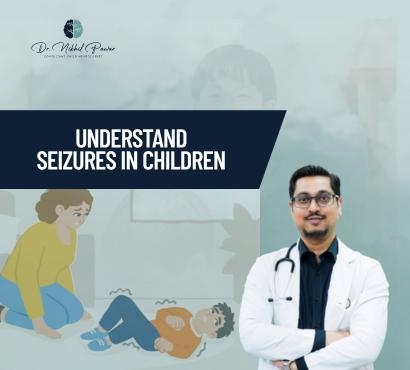
Seizures in Children
When to See a Pediatric Neurologist and What Tests Are Needed
A practical guide for parents
A seizure does not always look like full-body shaking. Some children stare, become briefly unresponsive, make repetitive movements, suddenly fall, or behave unusually. Knowing what to observe – and what to do – can make the evaluation safer and more accurate.
Seeing a child suddenly become unresponsive, stiff, shake, stare blankly, or make unusual movements can be frightening. Parents usually want to know three things immediately: Was this a seizure? Is my child in danger? Does this mean epilepsy?
A seizure is a temporary disturbance of brain electrical activity that can affect movement, awareness, behaviour, sensation, or a combination of these. Importantly, one seizure does not automatically mean epilepsy. Fever, metabolic disturbances, infection, head injury and other acute problems can provoke seizures, while some children may have recurrent unprovoked seizures that require further neurological evaluation.
What exactly is a seizure?
A seizure occurs when there is a sudden episode of abnormal electrical activity in the brain. Because different brain regions control different functions, seizures can look very different from one child to another.
- Stiffening or rhythmic jerking of part or all of the body
- Sudden loss or alteration of awareness
- Blank staring with failure to respond
- Eyes or head turning to one side
- Sudden falls or loss of muscle tone
- Repetitive movements such as lip-smacking, chewing, picking or fumbling
- Temporary inability to speak or respond
- Unusual sensations, fear, confusion or behaviour
Some seizures are subtle. Recurrent episodes in which a child abruptly stops an activity, becomes unresponsive for a few seconds and then resumes may be mistaken for daydreaming. The stereotyped, repeated pattern of an event is often an important clue.
Does one seizure mean epilepsy?
No. A seizure is an event; epilepsy is a neurological disorder characterised by an enduring predisposition to recurrent unprovoked seizures. The diagnosis depends on the clinical history and, when appropriate, EEG, imaging and other investigations.
A seizure may occur in association with fever, low blood glucose, electrolyte disturbances, infection, medication or toxin exposure, acute brain injury, or another temporary trigger. Conversely, an unprovoked seizure may sometimes be the first presentation of an epilepsy syndrome.
Key message
Do not label a child as having epilepsy simply because one episode of shaking or unresponsiveness has occurred. The circumstances and semiology of the event matter.
What can cause seizures in children?
The likely causes vary with the child’s age, development, medical history and seizure type. Important categories include:
- Fever: febrile seizures occur in some young children during a febrile illness.
- Genetic factors: some epilepsy syndromes have a genetic basis even when neither parent has epilepsy.
- Structural or developmental brain conditions: cortical malformations, previous brain injury and other structural abnormalities may increase seizure risk.
- Central nervous system infection: meningitis, encephalitis and related illnesses can present with seizures.
- Head injury: significant traumatic brain injury may be associated with acute or later seizures.
- Metabolic disturbances: abnormalities of glucose, sodium, calcium and other metabolic parameters can provoke seizures.
What should parents do during a convulsive seizure?
The immediate priority is safety.
- Move sharp, hard, hot or dangerous objects away from the child.
- Protect the head with something soft if possible.
- Do not restrain the child’s movements.
- Do not force the mouth open and do not put fingers, spoons, cloth, food, water or medicine into the mouth.
- Time the seizure from the beginning.
- When feasible and safe, position the child on the side, particularly as the convulsion settles, to help maintain a clear airway.
- Stay with the child and observe breathing and recovery.
Never put anything in the mouth
A child cannot “swallow the tongue”. Putting an object or fingers into the mouth can cause dental injury, aspiration or injury to the caregiver.
When is a seizure an emergency?
Seek urgent emergency medical care when:
- A convulsive seizure lasts 5 minutes or longer, or continues beyond the child’s prescribed emergency plan.
- Another seizure begins before the child has recovered.
- The child has difficulty breathing, persistent cyanosis, or does not recover as expected.
- There is serious injury.
- The seizure occurs in water.
- The child is severely ill or has concerning neurological symptoms such as new weakness or persistent altered consciousness.
- The treating clinician has advised emergency assessment because of the child’s age, underlying condition, or seizure pattern.
A first suspected seizure should be medically assessed. Whether it requires an ambulance or emergency department evaluation depends on the event, recovery and clinical context.
Why a mobile-phone video can be extremely helpful
If the child is safe and emergency care is not being delayed, a video can provide valuable diagnostic information. Try to capture the whole child and, if possible, the face and eyes.
- How the episode started
- Eye or head deviation
- Which body part moved first
- Whether movements were symmetrical
- Whether the child responded to name or touch
- Approximate duration
- Behaviour immediately after the event
Never delay first aid or emergency care simply to obtain a video.
When should a child see a pediatric neurologist?
Specialist assessment is particularly useful when:
- Seizures or unexplained episodes happen more than once
- Events occur without an obvious acute trigger
- There are recurrent staring or unresponsive spells
- Episodes include stereotyped automatisms or unusual movements with impaired awareness
- Seizures arise during sleep
- There are developmental concerns or loss of previously acquired skills
- There is new weakness, imbalance or change in walking
- The neurological examination is abnormal
- The episodes are increasing in frequency or changing in pattern
- The diagnosis remains uncertain and seizure mimics need to be considered
What happens during a pediatric neurology consultation?
The most important “test” is often a careful history. The Pediatric Neurologist reconstructs the event from beginning to end and considers the child’s age, development and neurological examination.
- Pregnancy, birth and developmental history
- Fever or illness around the event
- Previous seizures, head injury or neurological illness
- Medication exposure and sleep pattern
- Family history of seizures or neurological disorders
- School performance and developmental concerns
- Detailed seizure semiology and recovery
- Neurological examination including strength, tone, reflexes, coordination, eye movements, gait and development
EEG: what does it tell us?
An electroencephalogram (EEG) records electrical activity from the brain using electrodes placed on the scalp. It does not send electricity into the brain.
EEG can support seizure classification, identify epileptiform abnormalities and help define certain epilepsy syndromes. However, EEG is not a simple “yes/no” test for epilepsy.
Important
A normal routine EEG does not exclude epilepsy. Epileptiform activity may not appear during a short recording, and some children with epilepsy have a normal interictal EEG.
Depending on the clinical question, the neurologist may recommend a routine EEG, sleep EEG, sleep-deprived EEG, prolonged recording or video-EEG monitoring. The type and timing of EEG should be selected to answer a specific clinical question.
MRI brain: does every child with a seizure need one?
No. MRI provides detailed structural images of the brain, but not every child with a single straightforward seizure requires immediate neuroimaging.
MRI becomes particularly relevant when the history or examination raises concern for an underlying structural cause, including:
- Focal-onset seizures
- Abnormal neurological examination or persistent focal neurological symptoms
- Developmental delay or developmental regression
- Certain epilepsy syndromes or unusual seizure patterns
- Other clinical features suggesting a structural brain abnormality
The need, timing and imaging protocol should be individualised. In selected epilepsy evaluations, a dedicated epilepsy-protocol MRI may provide more useful structural information than a generic scan.
Blood tests, metabolic tests and genetic testing
Blood tests are not required in exactly the same way for every child. They may be useful when the clinical setting suggests an acute metabolic or medical trigger, such as abnormal blood glucose, sodium, calcium, systemic illness or infection.
Additional metabolic or genetic investigations are considered selectively. Genetic testing may be particularly useful in certain early-onset epilepsies, developmental and epileptic encephalopathies, children with developmental concerns, characteristic epilepsy syndromes, or when the phenotype/family history suggests a genetic disorder.
The principle
Investigations should answer a clinical question. Ordering every available test does not necessarily produce better care.
What if the seizure happened with fever?
Febrile seizures occur in young children in association with fever and are distinct from epilepsy. Many are brief and have a favourable long-term outcome.
However, a child with fever and a seizure still needs assessment in the appropriate clinical context, particularly to exclude serious infection when suggested by the history or examination.
Features that deserve closer assessment include prolonged seizures, focal features, repeated seizures during the same illness, prolonged altered consciousness, meningeal signs, toxic appearance, or other neurological abnormalities.
Will treatment be started after the first seizure?
Not necessarily. Anti-seizure medication is not automatically required after every first seizure. The decision depends on the nature of the event, likelihood of recurrence, seizure type or syndrome, EEG findings, imaging findings, neurological examination and underlying cause.
When medication is indicated, the choice is individualised according to seizure type, age, weight, comorbidities, potential adverse effects and other medicines. Parents should not start, stop or alter anti-seizure medication without medical guidance.
What should parents track at home?
For recurrent events, a seizure diary can be remarkably useful. Record:
- Date, time and duration
- What the child was doing immediately beforehand
- Fever, illness or sleep deprivation
- How the episode started
- Eye position and body part involved first
- Whether the child responded
- How the episode ended
- Recovery time and behaviour afterward
- Any prescribed rescue medication that was given
- A video, when safe and practical
Everyday safety
Children with seizures should not automatically be excluded from normal childhood activities. Precautions should be proportionate to seizure type, frequency and degree of control.
- Swimming and bathing require appropriate supervision.
- Take extra care around heights, fire, hot surfaces and potentially dangerous machinery.
- Cycling and sports precautions should be individualised.
- Teachers and caregivers should know what to do if a seizure occurs.
- Children with recurrent epilepsy may benefit from a written seizure action plan.
The aim is sensible safety without unnecessary restriction.
Not every unusual episode is a seizure
Several common childhood events can resemble epilepsy. Depending on age and semiology, possibilities include fainting (syncope), breath-holding spells, tics, stereotypies, sleep-related events, behavioural episodes and other non-epileptic paroxysmal events.
This is one reason a detailed history and video are often more informative than simply describing an event as a “fit” or “seizure”.
Red flags that should not be ignored
- Repeated unexplained episodes of unresponsiveness
- Recurrent stereotyped staring spells
- Recurrent convulsions or unexplained falls
- Seizures during sleep
- New focal weakness or persistent neurological deficit
- New difficulty walking or persistent balance problems
- Developmental regression – loss of previously acquired language, motor or social abilities
- Persistent change in awareness or behaviour associated with recurrent unusual episodes
Developmental regression is particularly important
Loss of previously acquired skills should prompt timely neurological evaluation rather than being attributed automatically to behaviour or an existing developmental diagnosis.
A note about autism and seizures
Autism and epilepsy can coexist, but not every unusual movement, staring episode or repetitive behaviour in a child with autism is epileptic. New episodes of impaired awareness, clear stereotyped events, developmental regression or other neurological changes deserve careful assessment.
Conclusion
Seizures in children can range from obvious convulsions to brief staring, unresponsiveness, repetitive movements or focal neurological events. A single seizure does not automatically mean epilepsy, and not every unusual movement is a seizure.
Parents can help enormously by keeping the child safe, timing the event, avoiding objects in the mouth, observing how the episode begins and ends, and recording a video when it is safe to do so.
EEG, MRI, blood tests and genetic investigations each answer different clinical questions and are not required routinely in every child. The best evaluation is individualised according to the child’s history, development, neurological examination and seizure semiology.
The goal of pediatric neurological assessment is not simply to attach a label. It is to establish the most accurate diagnosis possible, estimate future risk, identify treatable causes, and give the family a clear plan for treatment and safety.
Frequently Asked Questions
1. Does one seizure mean my child has epilepsy?
No. A single seizure can occur for several reasons and does not by itself establish epilepsy. The circumstances, recurrence risk and overall clinical evaluation determine the diagnosis.
2. Can a child have epilepsy even if the EEG is normal?
Yes. A normal routine EEG does not rule out epilepsy. EEG findings must always be interpreted together with the clinical history.
3. Does every child need an MRI after a seizure?
No. MRI is selected according to the seizure type, neurological examination, development and concern for an underlying structural abnormality.
4. What should I do if my child has another convulsive seizure at home?
Keep the child away from hazards, protect the head, do not restrain the movements, do not put anything in the mouth, and time the seizure. Follow the child’s prescribed seizure action plan if one exists. Seek emergency help for a prolonged seizure, breathing difficulty, serious injury, repeated seizures without recovery, or other concerning features.
5. Should I record the episode on my phone?
If the child is safe and recording does not delay first aid or emergency care, a video can be very helpful. Try to capture the face, eyes and whole body and continue long enough to show the recovery phase.
6. Are all staring spells seizures?
No. Daydreaming, behavioural inattention and other non-epileptic events can resemble seizures. Recurrent, stereotyped spells with impaired responsiveness deserve assessment.
About the author
Dr Nikhil Pawar
Consultant Pediatric Neurologist, Nashik
This article is intended for general parent education and does not replace individual medical assessment or emergency care.